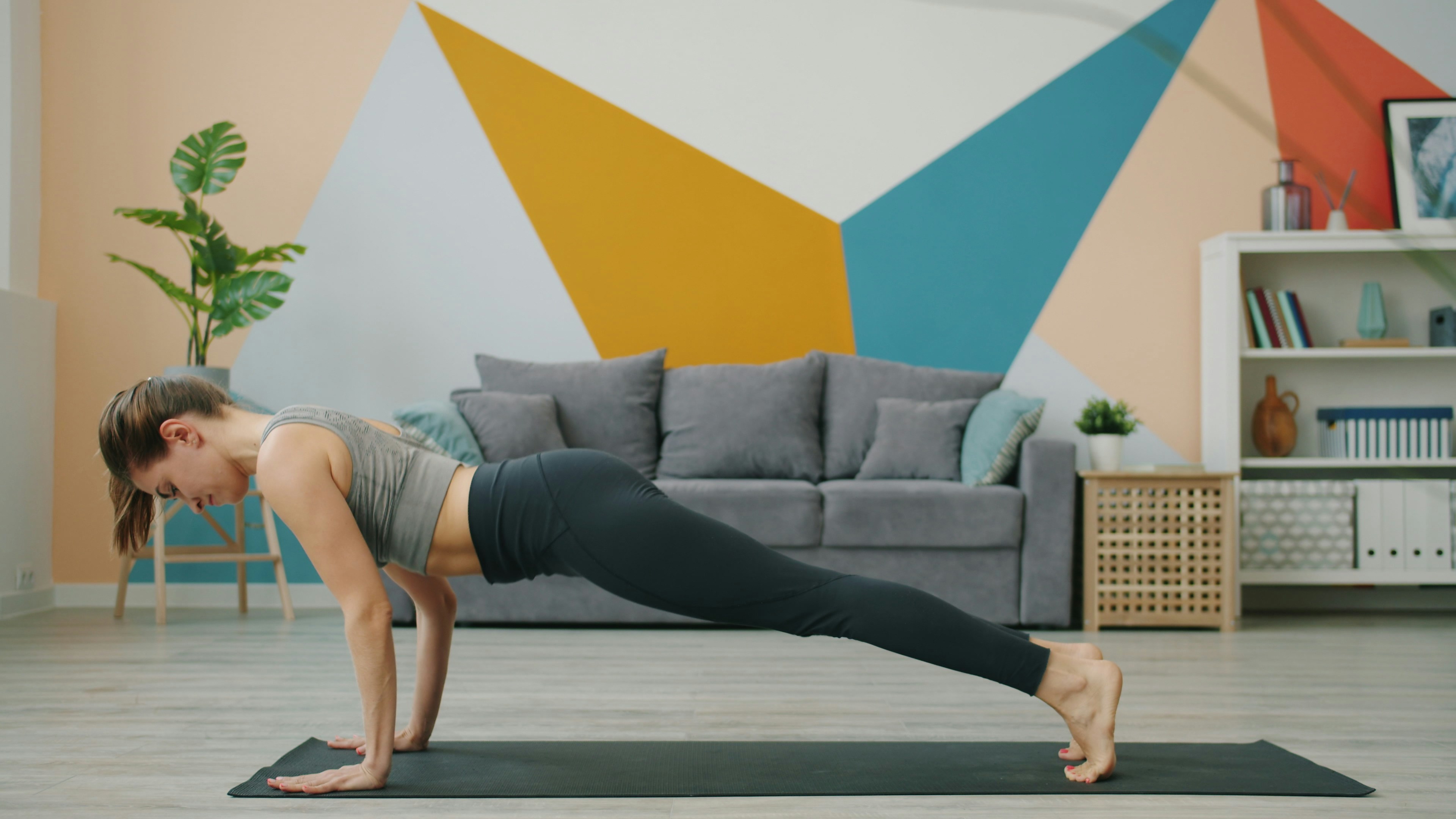
Every piece of cardio equipment on this site solves the same underlying problem in a different way: how do you get your heart rate up without sending vibration through the floor. The cheapest, most available answer is also the one most "apartment workout" lists skip entirely — a bodyweight circuit that's built from the ground up to avoid impact, not just a jumping-jack routine with the volume turned down. This isn't a gentler version of a real workout. It's a full 20-minute circuit, no equipment required, designed specifically around the one variable that actually determines whether your downstairs neighbor notices: feet leaving the ground.
Why "low-impact" doesn't mean "low-effort"
The thing that travels through a floor to a downstairs neighbor is vertical force — feet leaving the ground and landing again, not how hard your heart is working. That means you can genuinely spike your heart rate through the roof without ever producing the thump that gets you a text from apartment 2B. Low-impact cardio swaps the jump in a jumping jack or the leap in a burpee for a controlled step or pulse, while keeping the muscle groups and pacing that make it real cardio.
This isn't the "gentle cardio for beginners" framing you'll find elsewhere — done at pace, with short rest, this circuit will get you breathing hard. It's just built to never leave the ground.
The 5-minute warm-up
Don't skip this — low-impact work still asks a lot of your joints through range of motion rather than impact, and a cold hip flexor doing pulses is how you tweak something.
- March in place, 1 minute — knees to hip height, arms driving
- Arm circles, 30 seconds each direction
- Standing side bends, 10 per side
- Torso twists, 20 total — feet planted, rotate through the waist, arms loose
- Bodyweight squats, slow tempo, 10 reps
The 15-minute main circuit — 3 rounds, 40 seconds work, 20 seconds rest
Run the eight moves below in order, then rest a full minute before repeating for round two and three. The 40/20 work-to-rest split is short enough that you'll want to stay standing between moves rather than dropping to the floor and back up, which also keeps the whole thing quieter.
- Standing mountain climbers — hands on a wall or counter, step (don't jump) knees toward your chest, alternating
- Squat pulses — hold a quarter-squat, small controlled pulses rather than standing fully up between reps
- Step-touches with punches — step side to side, throw a punch on each step
- Glute bridge pulses — on your back, small pulses at the top of the bridge
- Standing bicycle crunches — hands behind head, opposite elbow to opposite knee, no jump
- Wall push-up bursts — hands on a wall, fast controlled reps for the full 40 seconds
- Shadow boxing combo — jab-cross-hook, moving your feet without leaving the ground
- Static lunge pulses, alternating sides each round — small pulses at the bottom of a held lunge
The 3-minute cool-down
Bring your heart rate down before you stop moving entirely rather than dropping straight to the floor.
- Standing forward fold, 30 seconds
- Standing quad stretch, both sides, 20 seconds each
- Seated hamstring stretch, both sides, 20 seconds each
- Seated forward fold, 30 seconds
- Deep breathing, 1 minute
What actually makes cardio "loud" (and how to make this even quieter)
If you're on a floor that transmits sound easily, or you've had noise complaints before even with careful movement, layering in a flooring mat under this circuit adds another buffer beyond just avoiding jumps — worth doing if you're on an upper floor over an occupied unit. Footwear matters too: bare feet or socks transmit less impact than shoes with a hard sole, even for low-impact moves like step-touches.
The other variable worth knowing: hardwood and tile carry impact noise further and more sharply than carpet does, so the same circuit that's a non-issue in a carpeted unit might still need a mat on hardwood.