Our guide to yoga and Pilates space requirements made a promise it didn't cash in: under 6x6 feet, you're not out of options, you're just doing a different kind of practice — more restorative, more seated, more balance-focused. This is that promise, delivered as five actual flows instead of a general reassurance. Each one below lists its real footprint, roughly how long it takes, and the one piece of gear worth having if any. None of them need the full 6x8 feet a moving vinyasa practice wants — that's the whole point.
Which flow fits your space and your day
Our guide to yoga and Pilates space requirements laid out the real numbers: a full vinyasa flow wants 6x8 feet, but a genuine 6x6 corner still works — you just trade wide lateral poses for restorative, seated, and balance-focused movement. These five flows are built for that smaller footprint specifically, not scaled-down versions of a bigger practice.
Pick by situation rather than trying to do all five: wind down after a long day, reset your core without needing floor width, use a literal corner via the 45-degree trick, wake up before the apartment gets busy, or spend five minutes with your legs up a wall when you have nothing left. Each one lists the actual footprint it needs and the one piece of gear (if any) worth having.
The Wind-Down Flow — 10 minutes, roughly 4x6 feet
This is close to what our space guide called restorative practice: almost everything happens seated or reclined, so it fits in less room than standing work ever will. Hold each shape for 5-8 slow breaths rather than rushing the sequence — the point is downshifting, not covering ground.
Start seated cross-legged for a minute of just breathing before moving into anything. Nothing here needs more than a mat's width in any direction.
- Seated breathing, 1 minute — cross-legged, hands on knees
- Seated forward fold — hinge from the hips, not the spine, let your back round
- Seated spinal twist, both sides — one hand behind you, one across the opposite knee
- Reclined figure-four stretch, both sides — ankle crossed over the opposite knee, lying on your back
- Reclined spinal twist, both sides — knees drop to one side, shoulders stay flat
- Child's pose, 1 minute — knees wide, arms extended or relaxed at your sides
- Final rest on your back, 2 minutes
The Core Control Flow — 8 minutes, needs more air than floor
This is straight from the Pilates side of our space breakdown: almost all the clearance this flow needs is vertical, not horizontal, since your legs move up and through an arc above your torso rather than out to the sides. A cleared 4-5 foot ceiling directly above your mat matters more here than room width does.
Move slower than feels natural — Pilates control comes from the transition between moves, not the position itself.
- The hundred — arms pumping at your sides, legs at tabletop or extended, 60-100 counts
- Single leg stretch, 10 per side — opposite knee pulled to chest, other leg extended
- Double leg stretch, 8 reps — both knees to chest, then extend arms and legs together
- Bridge, 8 reps — feet hip-width, lift through the hips, lower with control
- Spine stretch forward, 6 reps — seated, legs extended, reach forward vertebra by vertebra
- Rest in a relaxed seated position, 1 minute
The Corner Diagonal Flow — 12 minutes, uses the 45-degree trick
Our space guide's biggest space-saving move was turning a mat diagonally into a corner instead of laying it flat against one wall — it buys real extra length in a square room. This flow is built around that setup specifically, using the diagonal for the two or three poses in the sequence that actually need more length than a straight-on 6x6 gives you.
Balance poses are also naturally footprint-efficient since you're standing on one point of contact, not spreading out — this flow leans on that.
- Mountain pose, 30 seconds — grounding before you start moving
- Standing forward fold — hinge at the hips, knees soft
- Low lunge, both sides — front knee over ankle, back knee down, using the corner's diagonal length
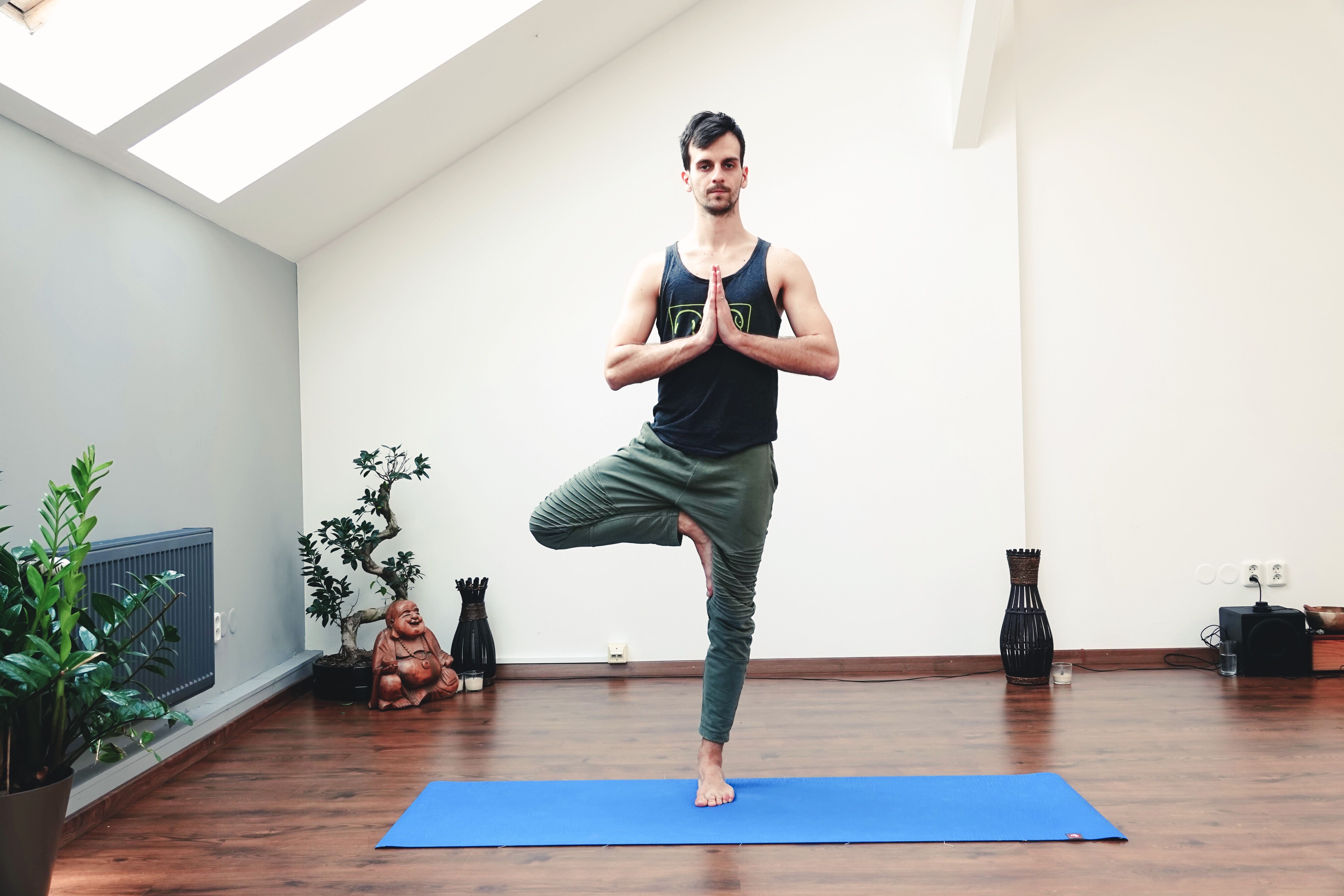
- Tree pose, both sides, 30 seconds each — foot to ankle or calf, hands at heart or overhead
- Warrior I in place, both sides — this is where the diagonal actually earns its keep, since a straight-on room usually can't fit the front-to-back stance
- Standing forward fold to release
- Mountain pose, 30 seconds — same spot you started
The Morning Reset Flow — 7 minutes, mixed standing and seated
Short and mixed on purpose — a handful of standing moves for circulation, then seated work to bring your heart rate back down before you actually start the day. Nothing here needs the full 6x8 footprint; this is closer to the 6x6 range with the corner trick optional, not required.
- Cat-cow, 8 rounds — on hands and knees, moving with your breath
- Standing forward fold to halfway lift, 5 reps — flat back on the lift, fold on the exhale
- Low lunge, both sides, 30 seconds each
- Seated spinal twist, both sides
- Seated forward fold, 1 minute
- Three deep breaths before you stand up and go
The Legs-Up-the-Wall Flow — 5 minutes, needs a wall more than a floor
This is the one pose our space guide almost undersells by not calling out on its own: legs-up-the-wall needs almost no floor width at all, just a clear stretch of wall and enough length lying down to reach it — genuinely one of the most space-efficient recovery moves that exists, apartment or otherwise.
- Sit sideways against a wall, then swing your legs up and lie back — hips as close to the wall as is comfortable
- Arms relaxed out to the sides or resting on your stomach
- Stay 3-5 minutes, breathing normally
- Bend your knees and roll to one side before sitting up, rather than sitting up straight from flat