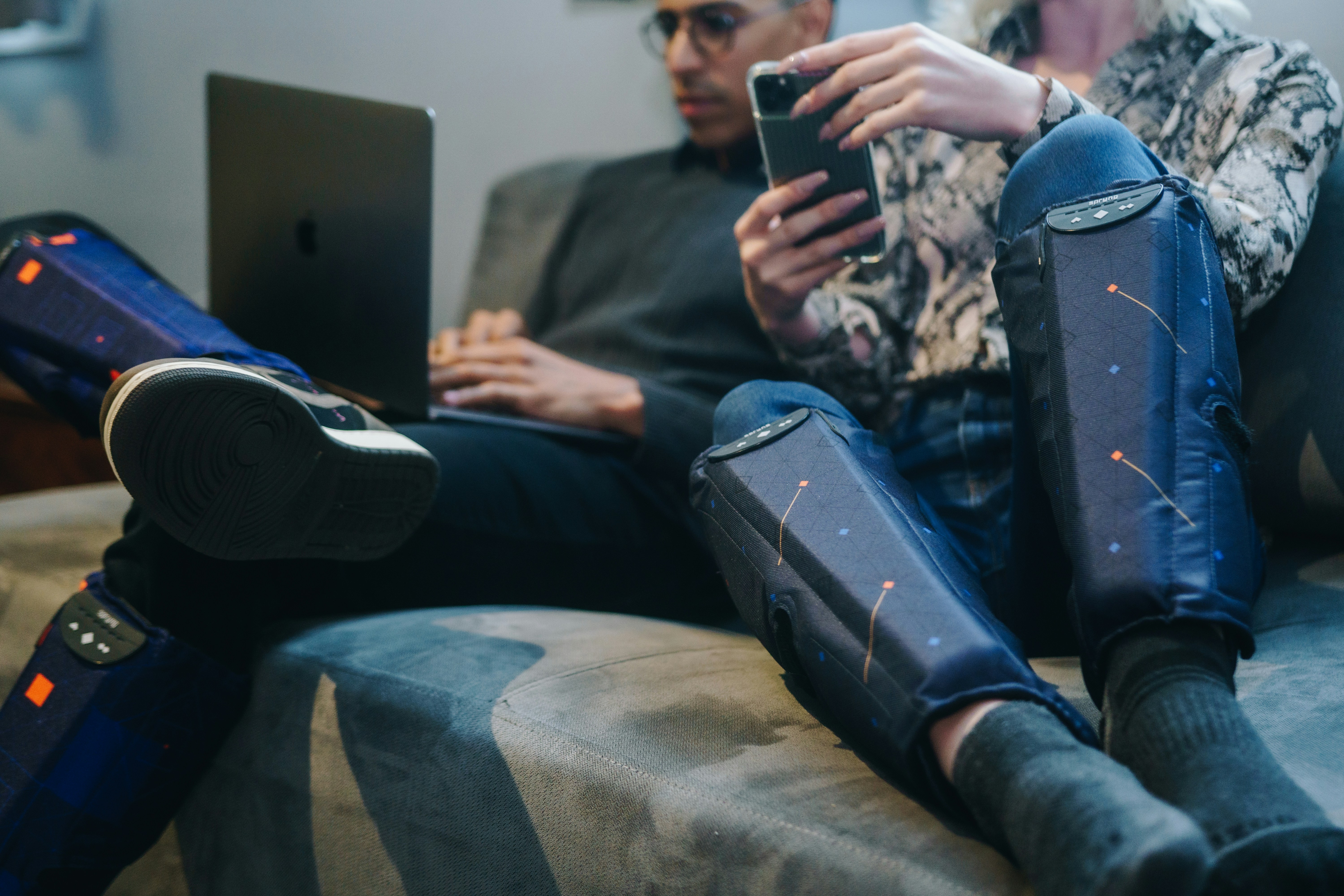
Most recovery gear assumes you have a room to put it in. A massage table, a foam rolling mat, a stretching corner — all of it wants floor space you probably don't have. Compression recovery boots are the rare exception: you sit down, strap them on, and let them do the work while you're on the couch, at your desk, or anywhere else you already spend time. No permanent footprint, nothing to trip over, nothing your downstairs neighbor can hear. That doesn't mean every pair on the market actually fits apartment life well. Some come with a separate pump unit connected by hoses — effectively a second object you need to find room for. Some are loud enough to notice through a thin wall. This guide covers what actually matters when you're choosing one for a small space, plus two picks that approach the job differently: a full-leg system built for real recovery depth, and a compact, calf-only option built around taking up as little room as possible.
Why compression boots are one of the few recovery tools that actually fit an apartment
Most recovery equipment is designed around the assumption of a dedicated room: a foam roller needs floor space to stretch out on, a massage table needs its own corner, even a simple stretching routine wants more open carpet than most studio apartments can spare. Compression boots skip that problem entirely — you use them seated, on furniture you already own, for 15 to 30 minutes at a time.
They're also quieter than most of the "powerful" recovery tools in this category. A massage gun has a percussive motor that's genuinely noticeable through a shared wall. Compression boots use a steady air pump that cycles on and off rather than vibrating continuously, which makes them a reasonable choice for an 9pm recovery session without worrying about a downstairs neighbor.
Comparison table
| Product | Price | Coverage | Apartment Footprint | Rating |
|---|---|---|---|---|
| FIT KING Air Compression Leg Massager | $339.99 | Full leg (feet, calves, thighs | Cordless, no pump box | 4.5★ (298) |
| Hyperice Normatec Go | $379.00 | Calf only | Smallest of the two, fully wireless | 4.4★ (204) |
Details above are editorial summaries and approximate street prices at the time of writing — confirm specifics on each current listing.
What actually matters when you're shopping for one in a small space
Four things matter more for apartment use than they do in a standard review: whether the pump is built into the boots themselves or sits in a separate control box connected by hoses (the second kind effectively needs two storage spots, not one), how loud the motor is during a cycle, how it charges (a cordless, rechargeable design means no permanent outlet commitment), and how compactly it folds down when you're done.
A unit that's genuinely cordless — battery and pump built into the boot itself — will almost always be easier to live with in a small space than a corded system with an external console, even if the corded version has more adjustment options on paper.
- Pump location: built into the boot vs. a separate control unit with hoses
- Noise: a cycling air pump vs. a continuous vibration motor
- Charging: rechargeable battery vs. wall-plugged for the full session
- Stored size: how small it packs down when you're not using it
Full-leg coverage vs. calf-only — which one you actually need
A full-leg system treats the feet, calves, and thighs together, which matters most after lower-body or running-heavy sessions where the fatigue isn't limited to one area. It's the more complete option, but it's also bulkier to put on, takes longer per session, and is a larger object to store even when it's cordless.
A calf-only design covers less ground but is faster to put on, lighter to hold, and takes up meaningfully less space in a drawer or closet shelf. For someone doing shorter, more frequent recovery sessions — a quick 15 minutes most evenings rather than a longer session twice a week — the smaller device often gets used more consistently simply because it's less of a production to set up.
How to actually fit this into a small routine, not a dedicated recovery room
The honest use case for most people isn't a quiet meditative recovery ritual — it's strapping the boots on while catching up on email, watching something, or scrolling on the couch. That's a feature, not a compromise: a tool that only works if you sit still and do nothing else gets used less often than one that fits into time you were already going to spend sitting down.
If you work from home in a small apartment, a desk chair session works just as well as a couch session, as long as the model you choose doesn't need you to stay perfectly still (most don't — you can type, read, or take calls through a full compression cycle)
What compression boots won't do, and when to just get more rest
Compression boots work by applying sequential pressure to encourage blood flow back toward the heart, which is why they're commonly used by athletes for perceived soreness and recovery comfort. They're not a substitute for sleep, hydration, or actually scaling back training volume when you're overtraining — a device can make sore legs feel better without addressing why they're sore in the first place.
They're also not appropriate for everyone. If you have a history of blood clots, deep vein thrombosis, or another circulatory condition, or if you're pregnant, talk to a doctor before using any compression device — this isn't a product category to self-diagnose around.
Storage and upkeep in an apartment-sized space
Wipe the interior lining down after sweaty sessions and let the boots air out before folding them away — trapped moisture is the main thing that shortens the life of the fabric and the zippers. A cordless model with no separate pump box stores flat in a drawer, on a closet shelf, or under a bed with the rest of your off-season gear.
If you're already working out how to fit recovery tools alongside other equipment in a one-room setup, the same principles that work for weights and bands apply here too.