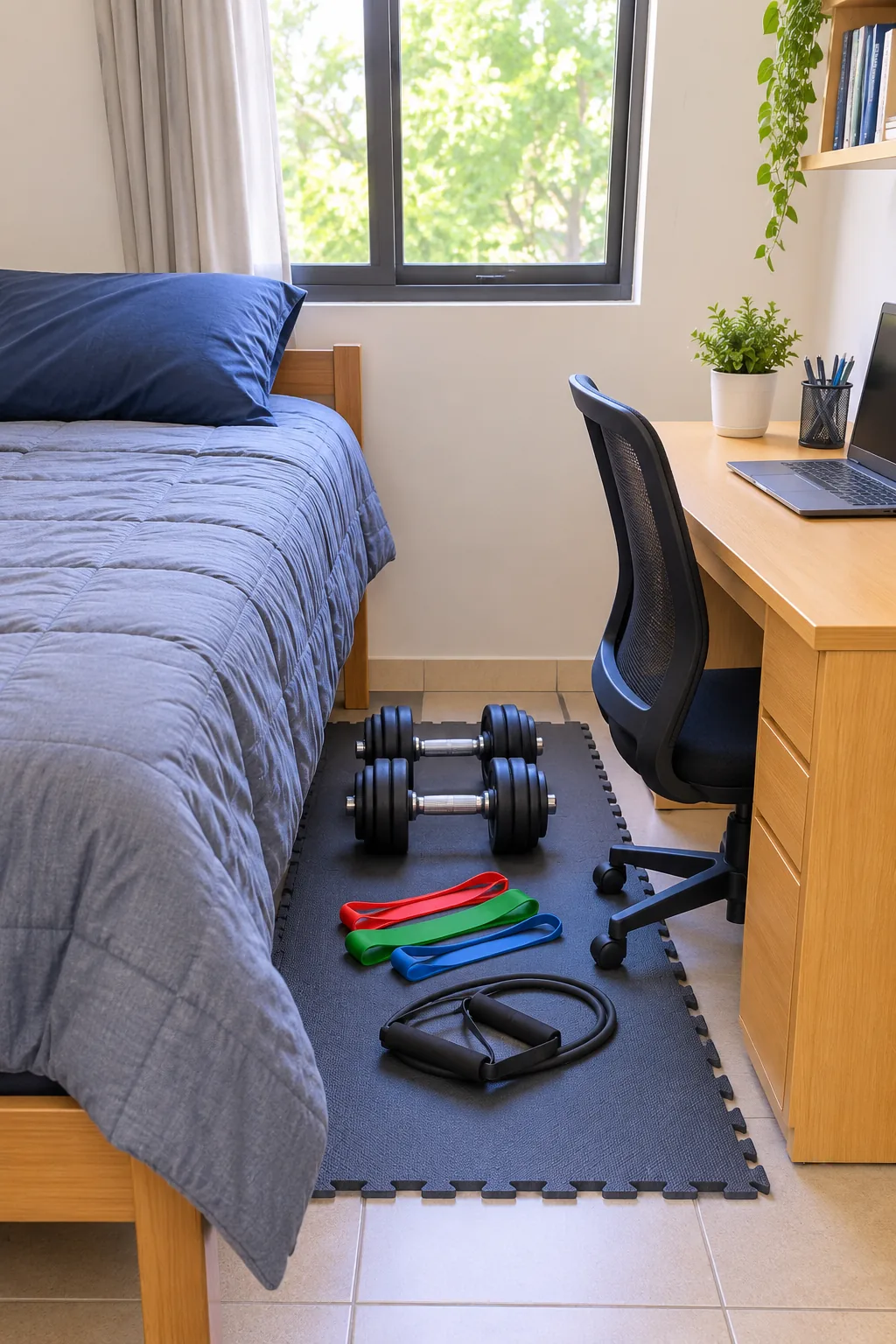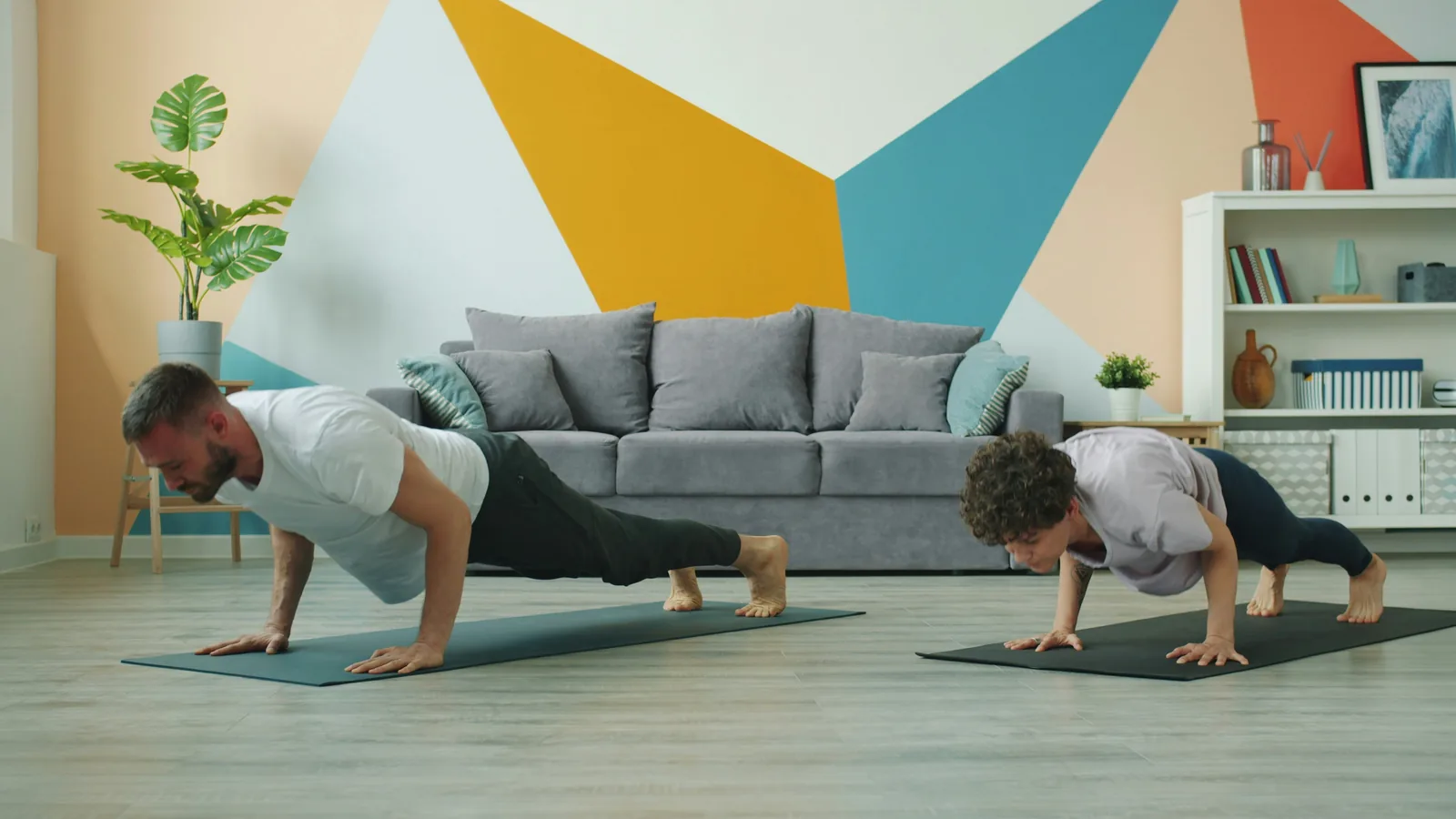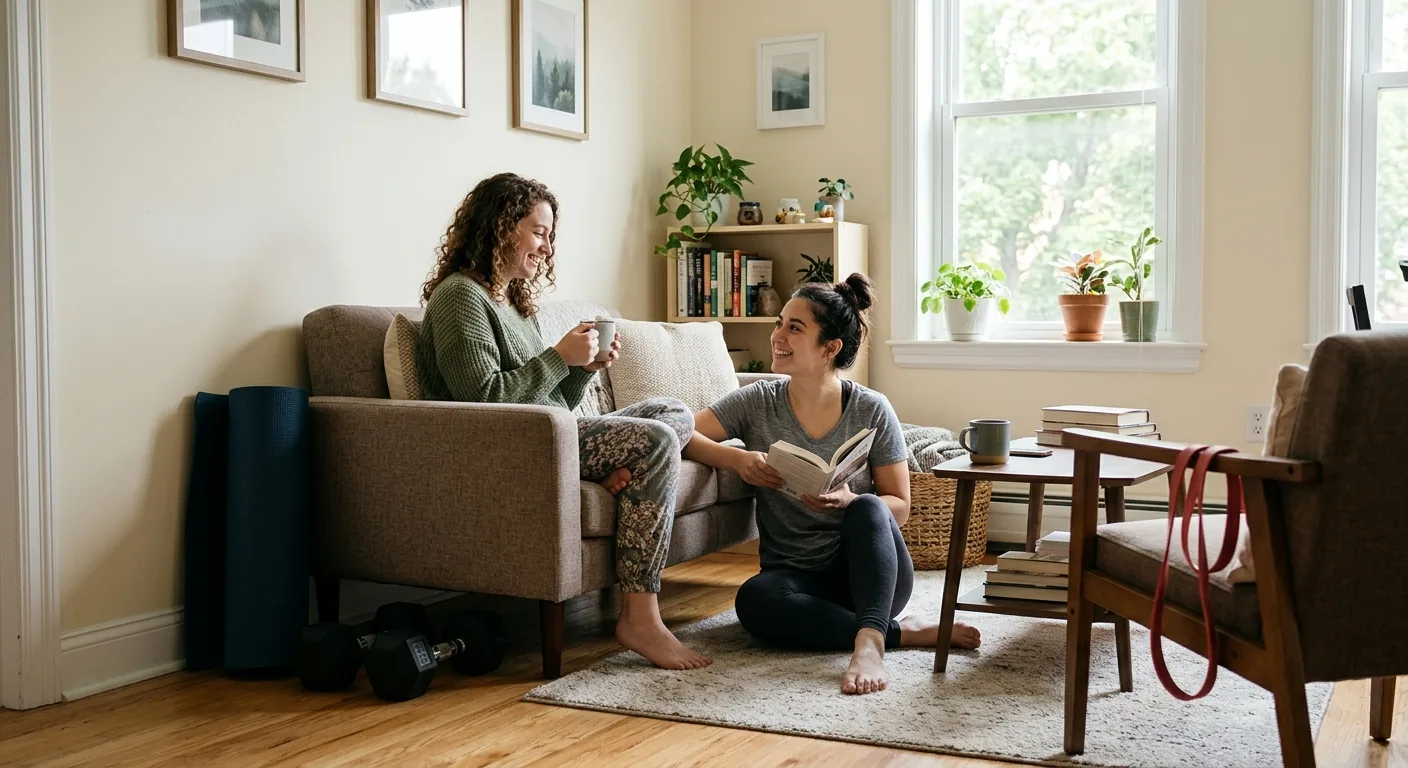
If your "home gym" is actually a corner of the living room you share with a couch, a TV, and possibly a partner or roommate who didn't sign up to look at a kettlebell every day, hiding your equipment isn't vanity. It's often the difference between a setup that survives and one that gets quietly vetoed after a month. Most advice on this topic is decorating advice: buy a storage ottoman, get a room divider, put the bands in a basket. That's not wrong, but it skips the part that actually matters for whether you keep training — every layer of concealment you add is also a layer of friction between you and starting a workout. This is the same "what actually gets in the way of consistency" question we've answered for space and equipment choices elsewhere on this site, applied to the specific problem of a gym that has to disappear when it's not in use.
The trade-off nobody mentions: concealment has a setup cost
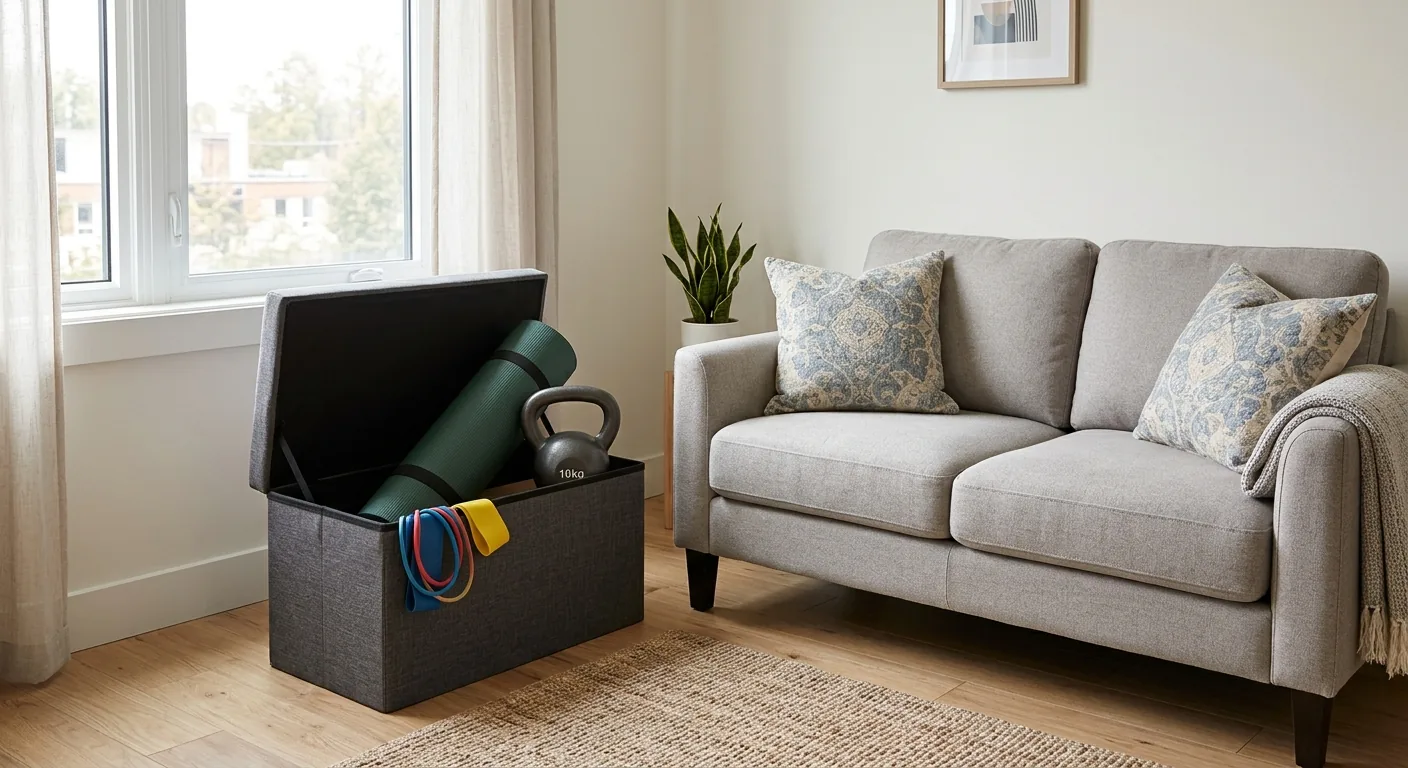
Every piece of advice about hiding a home gym boils down to the same mechanism: put the equipment somewhere closed, then take it back out when you want to train. A storage ottoman, a decorative basket, a closet, a room divider — all of them trade visual clutter for a small chore standing between you and your workout.
That chore is bigger than it sounds on the day you're least motivated to do it. We've written before about why most home gyms fail in the first two weeks, and "the setup took longer than the workout felt worth" is one of the quieter versions of that failure — it rarely gets blamed directly, it just shows up as skipped sessions. A fully concealed setup that takes 90 seconds to unpack and 90 seconds to put away again adds three minutes of friction to every single workout, twice a day if you count needing it visible as a reminder to actually do it.
The fix isn't to abandon hiding your equipment — it's to decide, on purpose, which pieces earn full concealment and which pieces stay out in a form your space can tolerate. That's a different question than "how do I hide a kettlebell," and it's the one that actually determines whether this works.
- Full concealment (closet, under the bed, a sealed ottoman) = lowest visual footprint, highest setup friction
- Partial concealment (open basket, a bin with a lid you flip, a floating shelf) = some visibility, near-zero friction
- Fully visible but intentional (one or two pieces styled like decor) = zero friction, most visual commitment
- Pick the friction level per piece based on how often you actually use it, not how it looks sitting out
What actually works for each type of equipment
Generic storage advice treats "workout equipment" as one category. In practice, what hides well and what should stay visible depends entirely on the item.
Mats are the easiest win and the one most apartment gyms get wrong first. A rolled yoga or exercise mat leaned in a corner reads as gym equipment; the same mat, if it's a solid neutral color, can stand upright in a tall basket or lean behind a floor lamp and pass as nothing in particular. This matters more than it seems — a mat is the single largest flat surface in most small setups, so it's doing a disproportionate amount of the visual work either way.
Dumbbells and kettlebells are the items people most want to hide and the ones storage furniture most often fails on quietly. A lot of storage ottomans and benches are rated for how much weight you can sit on, not how much dead weight you can load into the storage compartment underneath a lid you're also sitting on. A single 25lb dumbbell pair plus a 15lb kettlebell is 65 lbs of concentrated weight sitting inside furniture that may only be tested for a person's static sitting weight distributed across four legs — check the actual storage weight rating, not just the seating weight rating, before you load one up. Open or lidless storage (a floor basket, a low shelf behind a sofa) avoids the problem entirely and is usually faster to access anyway.
Bands and loop bands genuinely disappear into almost anything — a drawer, a basket, a hook on the inside of a closet door — because they're light and flexible. There's no real trade-off here; always fully conceal these, they add no friction worth worrying about.
Foldable benches, steppers, and bikes are the hardest case, because "foldable" doesn't automatically mean easy to tuck away — we've covered this mistake in detail elsewhere: some foldable equipment stores upright in a way that still occupies real floor footprint, or the fold itself takes real physical effort each time. If a piece is genuinely heavy or awkward to fold, it belongs in the "stays visible, styled as decor" category rather than the "hidden every time" category, or it simply won't get put away consistently and the mat on the floor nearby becomes permanent clutter regardless of what the furniture was supposed to solve.
If you want storage ideas that go beyond concealment entirely — repurposing furniture you already own, maximizing an entry closet, making use of vertical wall space — we've written a full studio-apartment storage hacks guide that covers that ground in more depth.
- Mats — easiest to conceal; a neutral color lets it lean in a corner or stand in a basket unnoticed
- Dumbbells/kettlebells — check the storage compartment's actual weight rating, not the seating rating, before loading it
- Bands/loop bands — fully conceal these always, they're light enough that it adds no real friction
- Foldable benches/steppers/bikes — if folding is genuinely a hassle, let it stay visible instead of forcing a daily hide-and-seek
Hiding equipment doesn't fix noise — don't confuse the two problems
A room divider, a decorative basket, or a closed ottoman solves a visibility problem. None of it does anything for an impact or vibration problem, and it's an easy mix-up to make because both problems involve the same living room.
If your downstairs-neighbor concerns are about a jump rope, a stepper, or dropped weights, the fix is a mat with real impact absorption and exercise placement away from load-bearing walls shared with a neighbor below — covered in our dedicated guide to apartment workout noise — not a screen that hides the equipment from view while doing nothing to the sound traveling through your floor. Treat concealment and noise control as two separate projects that happen to live in the same room; solving one doesn't touch the other.
- Concealing equipment solves a visibility problem, not a noise problem
- If a downstairs neighbor is the real concern, the fix is an impact-absorbing mat and smart equipment placement -- not a divider or ottoman
- Treat hiding your gym and quieting your gym as two separate projects that just happen to share a room
The quick-hide system: for guests, inspections, and roommates
There's a specific version of this problem that's less about everyday aesthetics and more about having a clear floor on short notice — a landlord's walkthrough, a roommate's visitors, a video call with your webcam pointed at the living room. That calls for a different setup than your everyday routine: a single large bin or basket that everything goes into at once, kept somewhere it can be grabbed in under a minute, rather than relying on each item's individual storage spot being tidy at the same time.
This matters most for renters specifically, since a home gym is one of the more common things that comes up in "will my landlord care" conversations — not because equipment itself usually violates a lease, but because a cluttered-looking space reads worse at a walkthrough than a tidy one, regardless of what's actually in it. A five-minute, one-bin reset before anyone comes over solves that without requiring your day-to-day setup to be fully concealed all the time.
If you're sharing the space with a roommate or partner who didn't choose to have a kettlebell near the TV, the honest move is agreeing on which 1-2 items can stay visible permanently (the ones you use almost daily) in exchange for everything else having a real, enforced hiding spot — a negotiated trade-off, not a unilateral one, holds up better long-term than quietly hoping they stop noticing.
If that negotiation is the part you're dreading, we've written a full guide to building a home gym in a shared apartment without annoying your roommate, with a more structured way to have that conversation.
- Keep one large bin or basket for a fast, everything-into-one-place reset before guests, landlord walkthroughs, or video calls
- A clear-looking floor reads better at a walkthrough than visible clutter, regardless of what's actually in your lease
- If you share the space, agree with your roommate or partner on 1-2 items that stay out permanently in exchange for a real hiding spot for everything else
How to build a home gym in a shared apartment without annoying your roommate