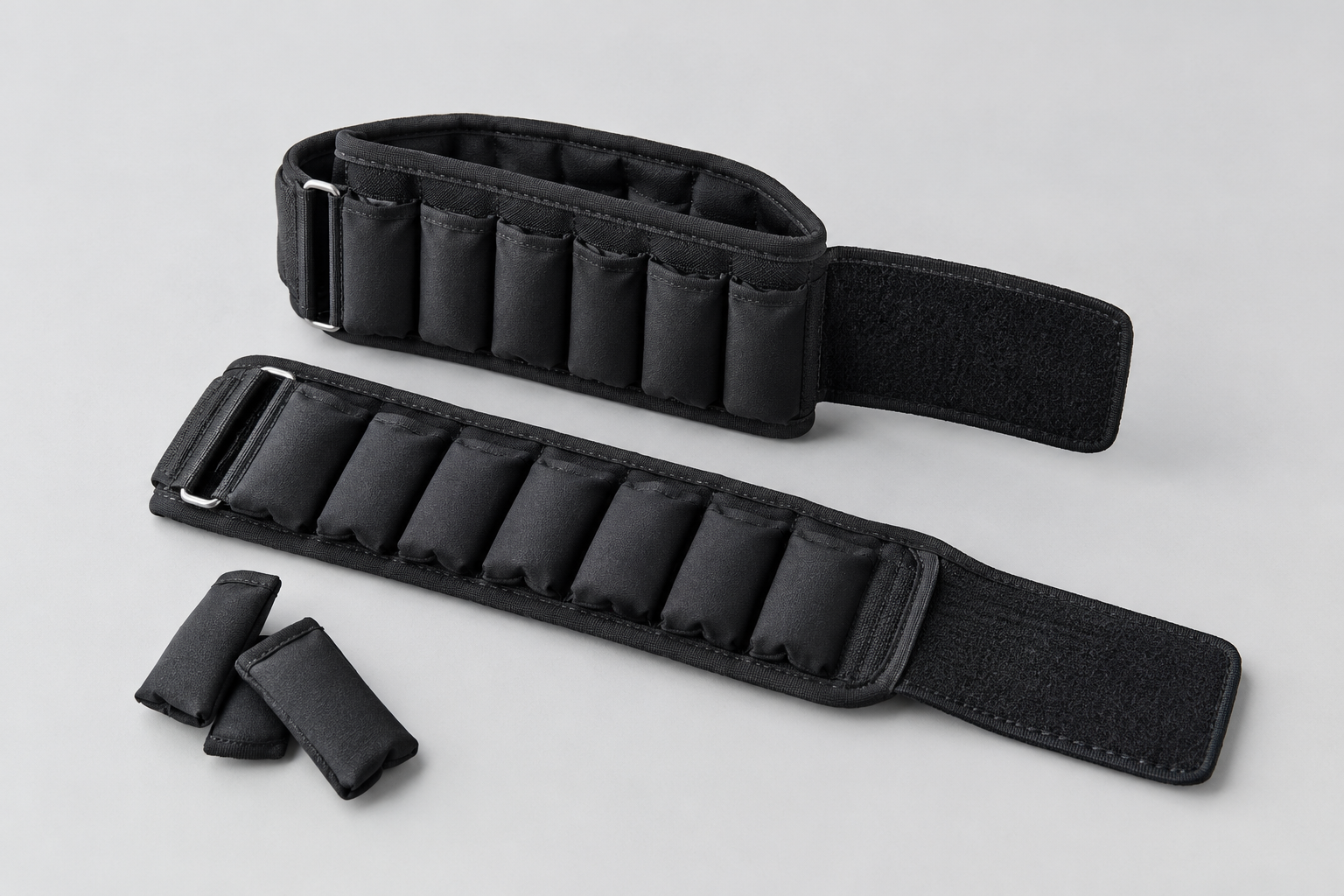
Almost every piece of strength equipment on this site comes with some version of the same apartment tax: a kettlebell needs a spot to live, a resistance band set needs an anchor point for half its exercises, a bench needs real floor space whether it folds or not. Ankle and wrist weights are the rare exception. You put them on, you train, you take them off and they go in a drawer — no footprint while you're using them, no noise, nothing to find a home for afterward. That doesn't mean any pair will do, or that more weight is automatically better. Ankle weights in particular get misused — strapped on for a run, or loaded heavier than a joint moving through a full range of motion should be asked to handle. Below are two picks built around genuinely different use cases (light and wearable vs. heavy and adjustable), plus the weight and form guidance that actually matters before you buy either one.
Quick answer: the two picks, and who each one is actually for
If you want something light enough to wear around the apartment during chores, walks, or bodyweight circuits without thinking about it, the Bala Bangles are the pick — 1 lb each, silicone-coated, genuinely comfortable for extended wear. If you want real added resistance for strength-focused leg work and a wide adjustable range as you get stronger, the Fragraim adjustable set goes from 1 lb up to 20 lb per side in small removable increments, which is a completely different tool for a completely different goal.
Both solve the same apartment problem — zero floor footprint, no noise, no storage planning — but they solve different training problems. Buying the wrong one for your actual goal is the real risk here, not product quality.
- Light, all-day wearable, fixed 1 lb — Bala Bangles
- Heavy, adjustable 1–20 lb, real strength resistance — Fragraim Adjustable Ankle Weights
- Neither needs floor space, makes noise, or needs a storage spot when you're done
Comparison table
| Product | Weight Range | Best For | Price |
|---|---|---|---|
| Bala Bangles Wrist & Ankle Weights | 1 lb (fixed) | All-day incidental wear, walking, bodyweight circuits | $55.00 |
| Fragraim Adjustable Ankle Weights | 1–20 lb (adjustable) | Dedicated, controlled strength sets for legs | $53.54 |
Details above are editorial summaries and approximate street prices at the time of writing — confirm specifics on each current listing.
Why this is one of the few strength categories with zero apartment downsides
Compare this to almost anything else on this site. An adjustable kettlebell still needs a spot to sit when you're not using it, and dropping one on a hard floor is a real noise and damage risk. Resistance bands are close — genuinely renter-friendly — but most of their exercise library needs an anchor point, which ankle and wrist weights never do. Our bands-vs-dumbbells comparison covers that anchor-point trade-off in more depth if you're deciding between categories.
Ankle and wrist weights sidestep all of it because the resistance travels with your body instead of sitting in the room. There's no equivalent of a kettlebell thunking onto hardwood, no cable or band snapping back if it slips, nothing that needs its own shelf. The honest trade-off: the resistance ceiling is much lower than free weights, and the exercises that benefit are narrower — this is a tool for targeted leg and arm work and light cardio resistance, not a replacement for your main strength training.
Best Adjustable Kettlebell for an Apartment
How much weight to actually start with, and the mistake that causes joint strain
More weight is not automatically better here, and this is where ankle weights specifically get misused. A joint moving through a full range of motion under added distal load (weight far from the joint, at the ankle or wrist rather than close to the body) puts more torque through that joint than the same weight would in a held position. That's exactly why 1–2 lb is the right starting point for ankle weights used during walking, bodyweight circuits, or cardio — not because manufacturers want to sell you a lighter product, but because anything heavier starts meaningfully loading the knee and hip joints during repetitive movement.
For controlled, limited-range strength exercises — leg lifts, glute kickbacks, seated leg extensions, standing hip abduction — you can reasonably go heavier, which is where an adjustable set like the Fragraim earns its range. The general guidance: light and fixed for anything involving walking, running, or continuous movement; heavier and adjustable only for slow, controlled, limited-range strength work where the joint isn't absorbing repeated impact.
One flat rule worth stating plainly: don't run or jog in ankle weights, at any weight. The repeated ground-impact load combined with distal weight is a well-documented way to aggravate the knees and ankles, and it's one of the most common misuses of this entire product category.
Wearable and fixed vs. heavy and adjustable: which one actually fits your training
The Bala Bangles work because they disappear into whatever else you're doing — folding laundry, a walk around the block, a bodyweight circuit — at a weight low enough that it's additive resistance, not a training stimulus on its own. They're not trying to be a strength tool; they're trying to be weight you forget you're wearing, which is a genuinely different design goal than most ankle weights on the market chase.
The Fragraim set is built for the opposite use case: a real, adjustable strength tool for targeted leg work, where you're deliberately choosing a weight for a specific exercise and changing it as you get stronger, the same way you'd think about a dumbbell. The removable weight packets mean you're not stuck at one resistance level the way a fixed pair would leave you — a real advantage once 1 lb from the Bala Bangles stops being a meaningful stimulus for seated or standing leg work.
Buying both isn't redundant if you actually use them for their intended purpose — light for all-day wear, heavy for dedicated sets — but if you only want one, match it to how you'll actually train: all-day incidental resistance, or scheduled strength sets.